
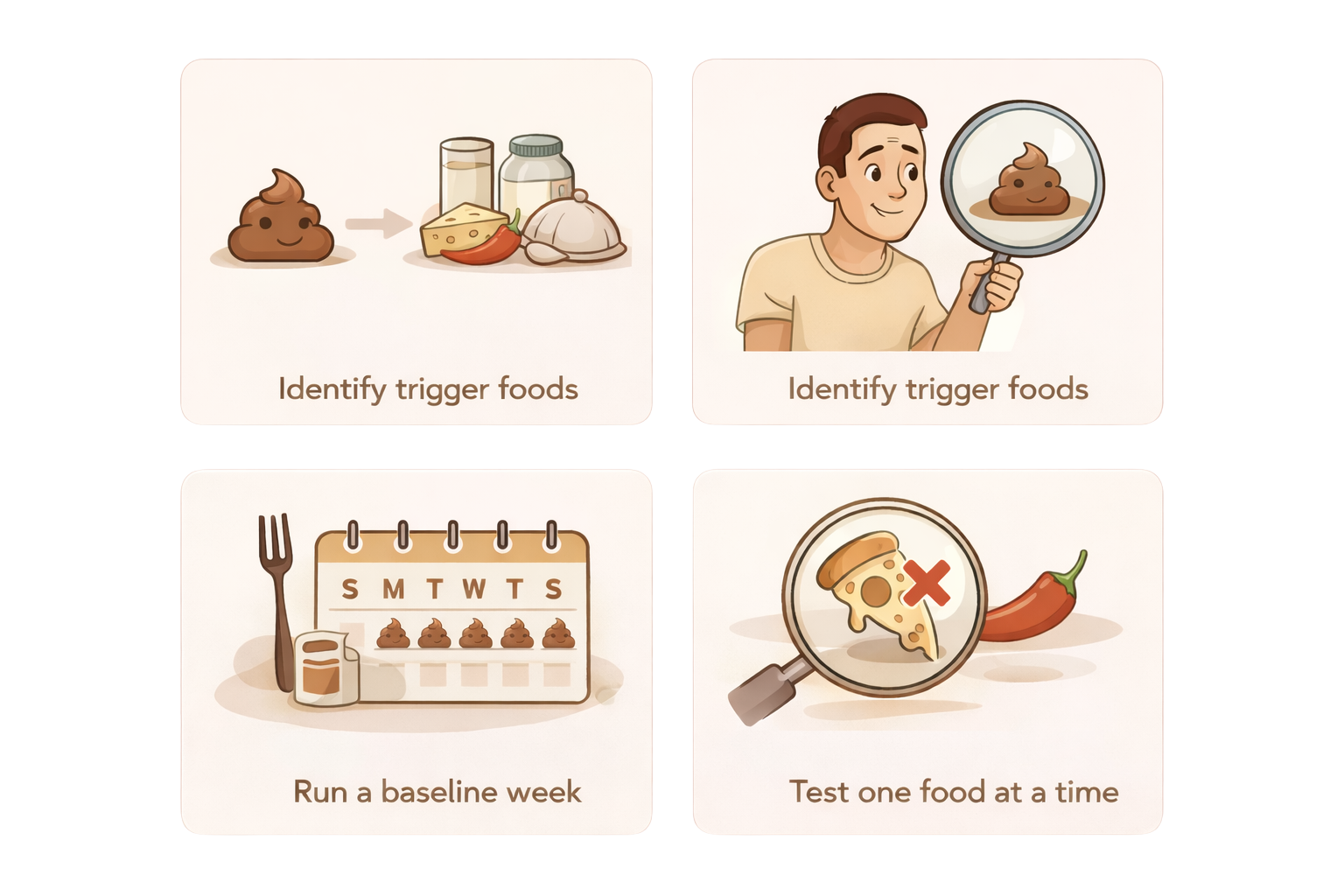
TL;DR
If you’re trying to figure out “what food did this,” don’t start by cutting everything.
A calmer method:
- Pick 1–2 metrics you can track (Bristol type + urgency is enough).
- Run a baseline week (don’t change your diet yet).
- Test one suspect for 7 days.
- If it helps, confirm it with a reintroduction challenge.
This is where StoolSense fits: it keeps the tracking part tiny (quick logs, consistent labels), so you can focus on the experiment — not the admin.
Step 0: Define what “triggered” means (pick 1–2 metrics)
Choose outcomes you can track consistently. The goal is signal, not perfection.
Good metrics:
- Stool form (Bristol Scale 1–7)
- Frequency
- Urgency
- Pain/cramps (0–10)
- Bloating (0–10)
Step 1: Run a baseline week (don’t change your diet yet)
For 7 days, don’t “fix” anything. Just observe.
Log:
- Meals (simple tags are enough)
- Stool timing + stool form
- Symptoms (urgency, pain, bloating)
- Confounders: stress, sleep, travel, illness, new supplements/meds
Baseline matters because it protects you from blaming the wrong thing.
Step 2: Build a short suspect list (3 candidates max)
Pick suspects based on your pattern.
If you’re often loose or urgent
Common suspects:
- Lactose (if you don’t digest it well)
- Coffee (especially on an empty stomach)
- Alcohol
- Spicy meals
- Sugar alcohols / polyols (often in “sugar-free” products)
If you’re often constipated or Type 1–2
Common suspects:
- Low fiber intake (or big fiber swings)
- Not enough fluid (especially when you add fiber)
- Routine swings (sleep, travel, meal timing)
- Sometimes dairy patterns (varies a lot person to person)
Step 3: Run a 7-day “single-change” elimination test
This is the core method: change one thing and watch the metrics.
Rules of a good test:
- Keep the rest of your diet as stable as possible
- Keep meal timing similar
- Don’t add a new supplement mid-test
- Track daily (tiny logs beat perfect logs)
Examples of clean 7-day tests:
- Lactose test: lactose dairy → lactose-free alternatives (same meals otherwise)
- Polyol test: remove sugar-free gum/candy/protein bars containing sorbitol/mannitol/xylitol
- Coffee test: half-caf or coffee after breakfast
- Spice test: keep spice level mild and stable
Step 4: Confirm with a reintroduction challenge (don’t skip this)
If symptoms improve during elimination, you still need to confirm it wasn’t coincidence.
A simple re-challenge:
- Day 1: small dose
- Day 2: medium dose
- Day 3: larger dose
If symptoms return in a dose-dependent way, your confidence goes up.
Bonus: challenges often reveal thresholds. Many “trigger foods” are only triggers above a certain dose.
Step 5: Avoid the restriction trap
Short-term restriction can be a useful tool for learning.
Long-term restriction without a plan often makes life worse and doesn’t always improve symptoms.
Mindset:
- Restrict briefly to learn
- Reintroduce to keep variety
- Keep only the smallest set of proven triggers
If you’re cutting major food groups long-term (dairy, grains, legumes), it’s worth involving a dietitian.
The “Trigger Food Test” template (copy/paste)
My 2 metrics: ________ and ________
Suspect food: ________
Test length: 7 days elimination + 3 days re-challenge
Daily:
- Meals + tags:
- Stool (time + form):
- Symptoms (0–10):
- Confounders (sleep/stress/travel/illness/meds):
Decision:
- Improved on elimination? Y/N
- Symptoms return on re-challenge? Y/N
- Conclusion: avoid / reduce dose / likely not a trigger
One last thing: memory is not a great food diary
When your gut has a bad day, it’s normal to replay the last meal and declare it guilty.
Tracking beats guessing because it turns “I think it was something I ate” into “here are the 2–3 patterns that keep showing up — and here’s the next clean test.”
If you want a structured place to start: